





.png)




.png)


















.png?width=32&height=32&name=CI%20Favicon%20Transparent%20(2).png)
You didn't choose your talent platform on a whim.
Whether you're running Workday, UKG, PageUp, Paylocity, Lever, or another enterprise-grade ATS, that decision involved demos, stakeholder alignment, implementation timelines, and probably more than a few late nights getting workflows configured just right.
So why does the background screening piece still feel like it's held together with duct tape?
If your team is toggling between systems, manually checking statuses, re-entering candidate data, or piecing together compliance documentation from three different sources, your integration isn't operating at the level your organization deserves.
Here's what enterprise-grade background screening integration should look like, and how to tell if your current setup is falling short.
Enterprise Integration Isn't Just "Connected"
Let's clear something up: having a technical connection between your ATS and your screening provider isn't the same as having a true integration.
Many organizations implemented their screening integration years ago - when their volume was different, their compliance requirements were simpler, or their ATS was a different platform entirely. The connection technically works, but it's not delivering the efficiency, visibility, or candidate experience that modern enterprise HR teams need. There's a spectrum of integration maturity worth understanding:
Basic connectivity means there's a link between systems - maybe single sign-on or a button that opens the screening portal in a new tab. But data doesn't flow automatically, statuses require manual checks, and the candidate experience feels disjointed.
Functional integration means candidate data passes from your ATS to the screening platform automatically. That's a meaningful improvement, but if status updates don't sync back, compliance documentation lives in a separate system, and reporting requires manual exports from multiple sources - you're still doing more work than necessary.
True enterprise integration means bi-directional data flow, real-time status visibility within your ATS, branded candidate communications, consolidated compliance documentation, and unified reporting that connects screening performance to your broader hiring metrics.
Most organizations think they're at level three when they're actually at level two. That gap is where inefficiency hides.
What Enterprise-Grade Integration Delivers
If your organization has invested in a sophisticated talent platform, your screening integration should deliver capabilities that match. Here's what to expect - and what to ask for if you're not getting it.
Seamless Data Flow (In Both Directions)
When a recruiter initiates a background check, candidate information should populate automatically - no re-keying names, dates of birth, Social Security numbers, or addresses. That's table stakes.
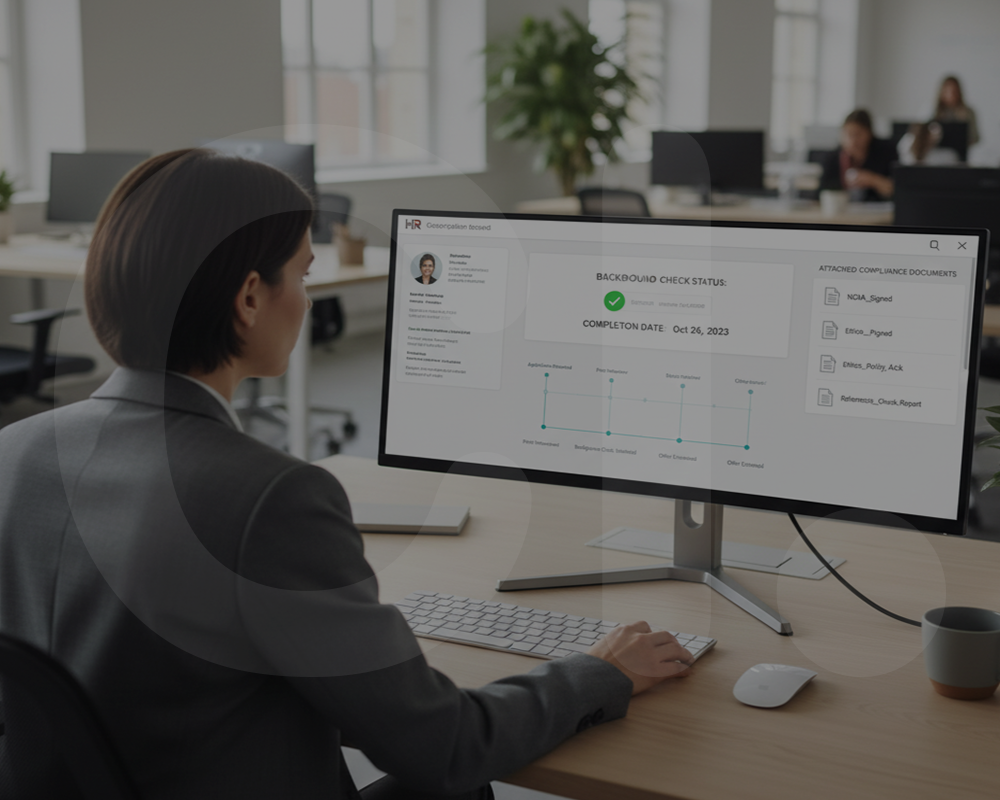
But true integration goes further. When screening status changes, that update should appear in your ATS in real time. When results come back, they should be accessible from the candidate record without logging into a separate system. When compliance documents are generated - disclosures, authorizations, adverse action notices - they should attach to the candidate file automatically.
This bi-directional flow eliminates the manual work that slows down hiring and creates opportunities for error.
Real-Time Visibility for Recruiters and Hiring Managers
"Let me check on that and get back to you" shouldn't be your team's default response when someone asks about a background check status.
With proper integration, recruiters can answer status questions instantly without leaving their primary workflow, without logging into another platform, without playing telephone between systems. Hiring managers with ATS access can see where things stand without pinging HR.
This isn't just about convenience. It's about speed. In competitive hiring markets - especially in healthcare, where a qualified candidate might have multiple offers - every hour of unnecessary delay is a risk.
A Candidate Experience That Matches Your Employer Brand
Candidates who've had a polished experience through your career site and interview process shouldn't suddenly feel like they've been handed off to some unknown third party when the background check begins.
Enterprise integration enables branded communications that look and feel like they're coming from your organization. It eliminates redundant data entry that frustrates candidates who've already provided their information. It provides clear expectations about timeline and process, with automated updates that replace silence with reassurance.
The background check phase is often the final impression before someone becomes an employee. A disjointed experience at this stage undermines all the goodwill you've built.
Consolidated Compliance Documentation
For organizations in regulated industries - healthcare, financial services, higher education, government - compliance isn't optional. FCRA requirements, state-specific regulations, industry mandates, and internal policies all create documentation requirements that must be met and provable.
Scattered records are a liability. If your disclosure lives in one system, the signed authorization in another, the results in a third place, and adverse action documentation in email threads -you're one audit away from a very bad day.
Enterprise integration consolidates the compliance trail. Every document connects to the candidate record in your ATS, timestamped and accessible. When legal or compliance needs to pull a file, it's all there - not scattered across platforms.
Reporting That Connects Screening to Hiring Outcomes
Your leadership team wants to understand hiring efficiency. They're asking questions like: What's our average time-to-hire? Where do bottlenecks occur? How do different roles or locations compare?
If screening is a black box that produces pass/fail results without any operational visibility, you're missing a critical piece of that picture.
Enterprise integration enables reporting that shows average turnaround times, completion rates by position type or location, where delays typically occur, and how the screening phase contributes to your overall time-to-fill. This data helps you identify opportunities for improvement and make informed decisions about your process.
When one of our healthcare clients implemented full integration, they gained visibility that helped them reduce pre-boarding time by 44%. A higher education client went from "multiple days" average turnaround to 0.57 days, with 85% of checks completed same-day. Those improvements came from having data to act on, not just results to file away.
Why This Matters More in Regulated Industries
If your organization operates in healthcare, financial services, higher education, or government, the stakes around screening integration are even higher.
These industries face layered compliance requirements that generic screening setups often can't accommodate. State-specific regulations, industry licensing requirements, exclusion database monitoring, credential verification, ongoing compliance tracking - the complexity compounds quickly.
A screening provider who treats integration as an afterthought won't have the infrastructure to support these requirements at the level enterprise organizations need. And an integration that worked fine when you were making 200 hires a year might buckle under the weight of 2,000.
Enterprise HR teams in regulated industries should expect their screening partner to understand their specific compliance landscape.
Signs Your Current Integration Isn't Enterprise-Grade
Not sure where your organization falls on the integration maturity spectrum? Here are some indicators that there's room to level up:
Your recruiters are still copying and pasting candidate data. If information that exists in your ATS has to be manually entered into the screening platform, you have connectivity, not integration.
Status checks require logging into a separate system. If your team can't see where a background check stands without leaving their ATS, you're missing real-time visibility.
Candidates ask why they're entering information twice. Redundant data entry is a candidate experience failure that proper integration eliminates.
Compliance documentation lives in multiple places. If pulling a complete candidate file for audit purposes requires accessing two or three systems, your compliance trail has gaps.
You can't report on screening metrics without manual data pulls. If answering questions about turnaround time or completion rates requires exporting from multiple sources and building spreadsheets, you're not getting the visibility enterprise teams need.
Your integration was set up years ago and never revisited. Platforms evolve. Your organization evolves. An integration configured in 2019 might not be optimized for 2026.
The Right Partner Makes the Difference
Integration quality isn't just about technology - it's about the screening partner behind it.
A provider who treats integration as a checkbox feature will give you basic connectivity and call it done. A partner who understands enterprise HR operations will work with you to configure an integration that supports your workflows, your compliance requirements, and your candidate experience standards.
At CIChecked, we've built integrations with 65+ ATS and HRIS platforms - including Workday, UKG, PageUp, Paylocity, Lever, and dozens more. But the number of integrations isn't the point. What matters is whether the integration delivers for your team.
That means bi-directional data flow, real-time status sync, branded candidate communications, consolidated compliance documentation, and reporting that connects screening to your hiring outcomes. It also means having a team that understands the specific requirements of your industry because integration that doesn't account for compliance complexity isn't really enterprise-grade.
Is Your Integration Delivering What You Expect?
If reading this article surfaced some doubts about whether your current setup is operating at the level your organization deserves, you're not alone. Most enterprise HR teams assume their integration is better than it is - until they see what's possible.
We work with organizations across healthcare, education, finance, and nonprofits to assess integration maturity and identify opportunities to improve. Sometimes it's a configuration adjustment on your existing connection. Sometimes it's enabling features that were never turned on. Sometimes it's a bigger conversation about whether your current provider can support what enterprise teams need.
Either way, you'll walk away with a clear picture of where you stand and what's achievable.
Ready to find out? Let's look at your integration together.